
How to reduce energy costs in professional kitchens
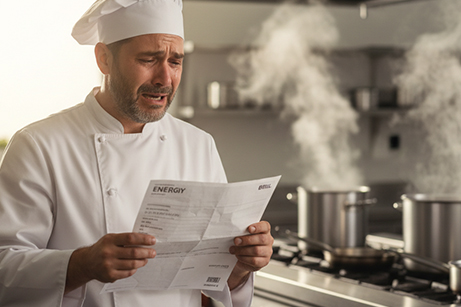
Energy costs are one of the most critical items affecting a restaurant’s profitability. They directly impact margins, work organization, and investment capacity.
Even when you know this, you may still feel powerless.
Have you ever wondered whether it is possible to reduce energy costs and save on utility bills?
The good news is that, with TNK, energy costs can be reduced, generating savings that can exceed €10,000 per year.
In a professional kitchen, real savings come from acting on several aspects at the same time: contracted power, equipment energy consumption, and operational organization.
This is where TNK technology can make a real difference, with energy management and energy-saving solutions that help contain both fixed and variable costs.
Why do energy costs weigh so heavily in the kitchen?
In the Ho.Re.Ca. sector, energy consumption is the result of a combination of factors:
- equipment left on longer than necessary
- uncontrolled power peaks
- oversized cooking lines
- refrigeration units with poor energy ratings
- poorly coordinated use of equipment
A kitchen often spends too much because it consumes energy inefficiently.
Inefficiency comes at a high cost, increasing fixed costs (electricity supply), variable costs (equipment consumption), and reducing profitability.
How to build a kitchen with low energy costs
A sustainable and profitable foodservice business must reduce energy costs by acting on three key factors:
- choosing high-performance, energy-saving equipment
- designing a kitchen system able to make better use of available energy
- cooking and blast chilling with full loads, optimizing production times
TNK technologies and products for energy savings
Balance: manage power intelligently
One of the most common issues in professional kitchens concerns installed power. Very often, businesses request more power than they actually need in order to avoid problems during peak working hours. This is understandable, but not always economically efficient.
Balance was created precisely to solve this issue and works in exactly the opposite way.
Balance is the Wi-Fi technology that allows the kitchen to operate with 50% of the nominal power while maintaining 100% performance.
What are the benefits?
- you reduce fixed costs because lower power levels are required
- you stay within supply limits and avoid unexpected costs
- you can save up to €20,000 compared with other “peak control” systems, because no building work or electrical system modifications are required thanks to the Wi-Fi connection
With Balance, you can rely on a more efficient, more sustainable kitchen that is also easier to integrate into complex projects, such as refurbishments or openings in locations with technical constraints.
Modular eROC: save while you work
While Balance acts on power management, eROC cooking modules improve efficiency by reducing variable costs.
This is a key point, because cooking equipment is among the main causes of energy consumption.
eROC automatically reduces electricity consumption, maintains the same cooking quality, and limits waste when the equipment is not actively cooking. This aligns with Modular’s official positioning for eROC.
What are the benefits?
- energy is used according to actual demand, eliminating waste
- service continuity and quality are maintained
- energy savings become structural and automatic, regardless of operator attention
With eROC, you can save up to 40% on energy costs.
Coldline: energy savings through refrigeration
A considerable share of consumption comes from refrigeration, which runs continuously, day and night.
This is why choosing efficient Coldline professional refrigerators, with high-performing energy classes, can have a major impact on the kitchen’s total energy costs, while also improving food preservation.
What benefits do you get?
- lower consumption
- better preservation of raw materials and semi-finished products
- reduced food waste
- more stable temperatures
Do you know how much energy you can save?
A Coldline class A refrigerator saves 72% energy compared with a class F model.
A Coldline class A refrigerated table saves 83% energy compared with a class F model.
Coldline’s efficient refrigeration improves preservation and reduces the risk of losing raw materials.
This means acting on two fronts at the same time:
- energy savings
- waste reduction
In a business where every margin point counts, these are essential factors.
Real savings come from integrating kitchen technologies
The TNK kitchen integrates products from Coldline, Modular, Nevo and Krupps, creating an ecosystem in which technologies work in synergy and maximize energy savings.
When choosing one or more pieces of equipment, the question you should ask is:
How much can this solution help me save?
In one of our customer’s kitchens, we calculated savings of more than €10,000 in one year.
How much could you save over 3, 5 or 10 years of business?
Energy saving is a strategic choice.
Appointments and News
View all news
Defrost safely with Thaw.Pro
Thaw.Pro is the new Coldline defrost cabinet that efficiently and safely brings large quantities of...
Read more
The prompt delivery stock is online!
Book from prompt delivery stock and receive the best cooling technology within hours. Choose from...
Read more
Gast + Kuche
From 29 to 30 March, we will be waiting for you in Passau, at the Lohberger booth, to let you...
Read more
Internorga
From 10 to 14 March, Coldline - booth B6-342 - attends the Internorga exhibition in Hamburg,...
Read more


Food Hotel Asia
From 25 to 28 October, Coldline - Hall 4, Stand 4J2-01 - participates in the FHA trade fair in...
Read more
Gonzaga Millennium Exhibition
3 to 11 September - Hall 3 Mantova Golosa Experience - Gonzaga (MN)
Read more
Siaf project
Coldline collaborates on the SIAF project which aims to design and build a software and hardware...
Read more
University of Gastronomic Sciences
We are pleased to announce the beginning of the collaboration between Coldline and the University of...
Read more